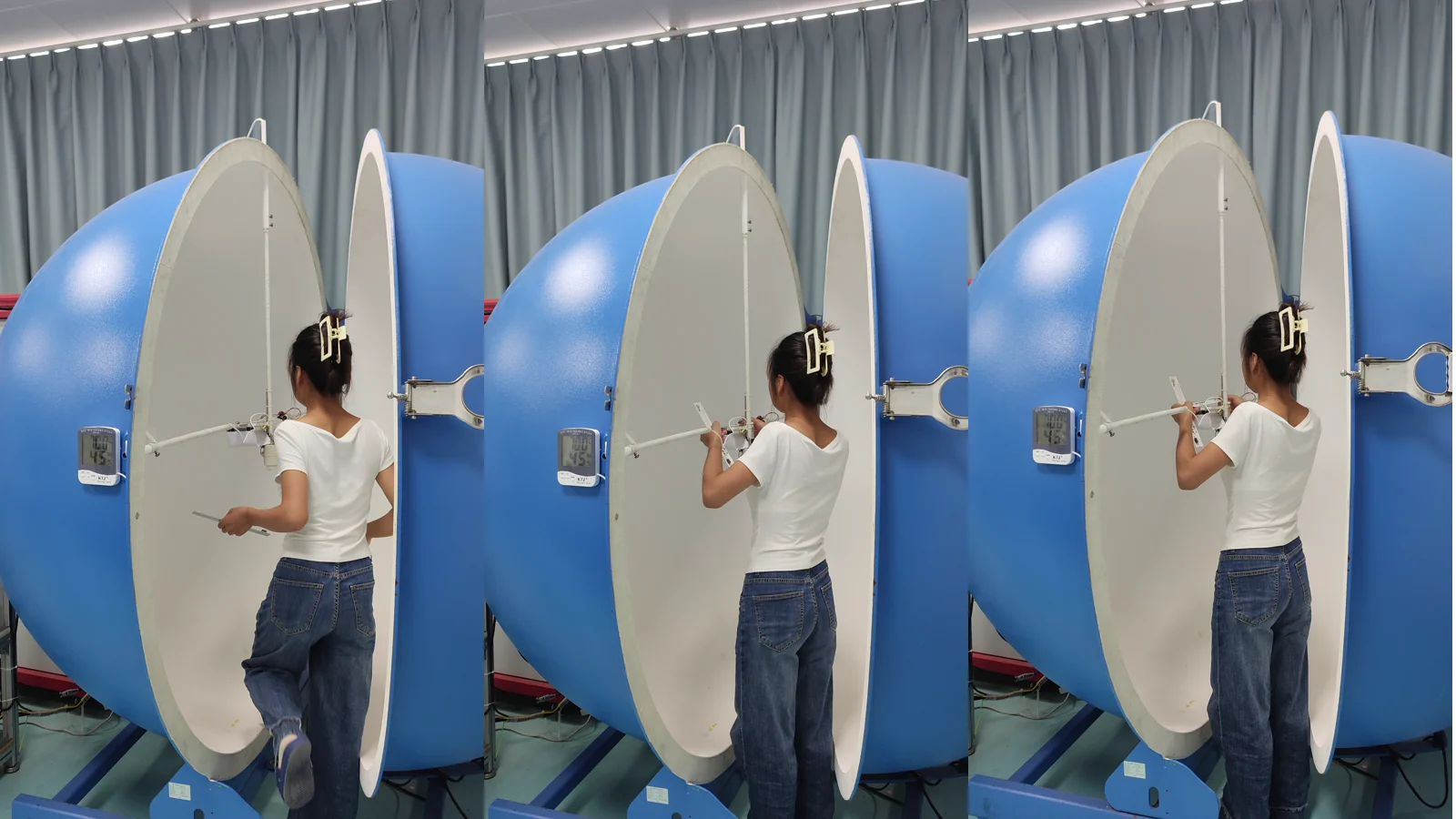
Three frames from supplied test footage at 0.5, 2.5 and 4.5 seconds. They show an operator positioning a light at an integrating sphere; they do not establish the sample identity, method, calibration, result, certification or ownership of the facility.
An integrating sphere can support a total light-output measurement, but a photo of the equipment does not verify a supplier's lumen claim. A useful report must identify the exact sample, operating mode, battery condition, measurement method, equipment, test timing and result.
For portable lights, total lumens are only one part of the buying decision. Beam shape, illuminance at a stated distance, colour appearance, runtime behaviour and any output reduction during use must be checked separately. A bright first reading does not by itself show how the product will perform through a shift or how useful the beam will be on a work surface.
This guide is for United Kingdom professional-tool distributors comparing OEM or ODM rechargeable torches and portable work lights before sample approval. It does not set a universal lumen target or prescribe one laboratory method. The buyer and supplier should agree the method and acceptance criteria for the exact product and claim.
Browse NIGHTFIELD buyer insights for related product-development and quality briefs.
Begin with the claim customers will actually see
The test brief should begin with the exact output claim planned for the product page, packaging or sales sheet. That keeps the measurement tied to a commercial decision.
Record the model, sample revision, selected mode and wording of the proposed claim. If a torch has boost, high, medium and low modes, "maximum output" is not enough. The supplier and buyer need to know which mode is being measured, how it is activated and whether it remains active for the measurement period.
Also decide whether the claim describes initial output, stabilised output, average output over a period or another defined value. Those descriptions answer different questions. A report should not quietly substitute one for another.
Know what each measurement can answer
An integrating-sphere result, beam measurement and runtime record are complementary. They should not be treated as interchangeable proof.
| Evidence | What it can help answer | What it does not answer by itself |
|---|---|---|
| Total luminous flux in lumens | How much visible light the complete sample emits under the stated setup | Where the light goes, beam reach, glare, runtime or durability |
| Illuminance in lux at a stated distance and position | How much light reaches a defined surface or point | Total output, full beam shape or performance at another distance |
| Beam images or mapped beam data | Whether the beam is broad, concentrated, even or affected by artefacts | A traceable lumen value unless the measurement method also provides it |
| Colour data, when measured | Correlated colour temperature, chromaticity or colour-rendering data included in the report | Whether the colour remains consistent between units or throughout runtime |
| Runtime and output-over-time record | How the selected mode changes as the light operates | Impact, water resistance, charging quality or long-term battery ageing |
For a close-range work light, usable coverage and glare on reflective surfaces may matter more than a narrow peak. For a directional torch, central intensity and the beam at the intended distance may matter alongside total flux. Write the use case before deciding which numbers belong in the approval sheet.
The existing vehicle repair lighting brief shows how mounting position and working distance change the product decision before a lumen target is chosen.
Lock the sample and operating condition
A comparable report identifies the physical unit and the state in which it was tested. Otherwise, a later sample can inherit a number it never produced.
Before measurement, record:
- model name and sample serial or unique identifier
- sample revision and relevant bill-of-material reference
- LED, optic, driver and battery version where they affect the approved configuration
- selected light mode and the exact control sequence used to reach it
- battery charge condition and charging or rest procedure before the test
- ambient and product preparation conditions required by the agreed method
- elapsed time between switch-on and the recorded reading
- any cooling, external power or non-standard setup used during the test
Do not accept "production sample" as the only identity. Optics, drivers, cells and firmware can change during development. The evidence should make clear which version produced the result and whether that version is the one being approved.
Define the integrating-sphere setup before testing
The useful question is not simply whether a sphere was used. It is whether the setup was appropriate, controlled and recorded for the sample.
Ask the test party to document the equipment identification, calibration status, sphere configuration, detector or spectrometer used, software version where relevant, mounting position and the method used to account for the sample and fixture inside the sphere. The report should also state whether the complete light or only a light source or subassembly was measured.
The supplied footage shows an operator and a large sphere. It does not reveal any of those details. That is why the image is process context, not a result.
When a buyer requires a named method or third-party report, agree the exact method, edition, reporting fields and laboratory responsibility before testing. Do not add a standard name to a purchase specification after the sample has already been measured and assume the existing data will qualify.
Measure the mode buyers intend to sell
Portable lights often use several output modes, and some modes change output automatically. The approval plan should say which modes need a declared value and when each value is recorded.
For every reported mode, capture the switch-on procedure, measurement timing and duration. If output falls during the observation window, preserve the curve or time-stamped readings rather than reporting only the highest point. If a temporary boost mode is part of the claim, its activation and duration need to be visible to the buyer.
Battery state also matters. Use the same agreed preparation for samples being compared. A fully charged development sample and a partly charged comparison sample do not create a fair supplier comparison, even if both readings are genuine.
Keep the wider rechargeable-product questions connected to the light-output review. The battery, charging and ageing buyer brief covers the use cycle and checks that one photometric reading cannot replace.
Ask for beam evidence beside the lumen value
Two lights with similar total output can place that light differently. A distributor therefore needs evidence tied to the intended task, not only one headline lumen figure.
For a directional torch, define the distance and positions used for illuminance or beam-intensity evidence. For an area or work light, define the working distance, orientation and surface being assessed. Keep camera settings fixed when photographs are used for comparison, and treat those photographs as visual support rather than measurement.
A simple comparison pack can include:
- the integrating-sphere report for the agreed modes
- a beam image made with a documented, repeatable setup
- illuminance readings at the stated distance and positions
- an output-over-time record for the mode relevant to the use case
- notes on visible flicker, control behaviour, heat-related changes or other observations
The objective is not to collect the most files. It is to connect each piece of evidence to a buyer question.
Build a comparison sheet that survives supplier changes
Use the same columns for every shortlisted sample. A consistent sheet makes gaps visible and prevents a polished report from receiving more weight than a comparable product result.
| Field | Record for every sample |
|---|---|
| Product identity | Model, sample ID, revision and date received |
| Approved configuration | LED, optic, driver, battery and firmware references as applicable |
| Declared mode | Mode name, activation sequence and proposed customer-facing claim |
| Preparation | Charge condition, rest period and other agreed preparation |
| Measurement | Method, equipment ID, calibration reference, setup and operator or laboratory |
| Timing | Switch-on time, reading time and total observation period |
| Results | Lumens and any agreed colour data, with units and status |
| Beam evidence | Distance, orientation, lux positions and controlled images where required |
| Runtime behaviour | Output-over-time file or readings for the agreed mode |
| Decision | Pass, fail, investigate or retest against written acceptance criteria |
Do not mix values from different samples to create one ideal specification. If the lumen result comes from one unit, the beam image from another and the runtime curve from a third, label that separation and decide whether it is acceptable for the current development stage.
Set acceptance rules before seeing the result
An approval rule should state the claimed value, tolerance or decision band, sample quantity, rounding rule, measurement timing and action for a result outside the agreed range. The actual values are product- and project-specific; they should not be copied from an unrelated torch.
Also define which changes trigger review. A change to the LED, optic, driver, battery, thermal path, firmware or housing can affect the output or beam. The buyer brief should state when a document review is enough and when a repeat measurement is required.
One successful development sample is not a production-control plan. Before release, decide how incoming or outgoing checks will confirm the correct configuration and which photometric measurements, if any, are repeated by batch or after a material change. NIGHTFIELD's manufacturing and quality coordination can help keep the approved sample, specification and evidence request connected across manufacturing partners.
Send this ten-point request with the sample
- Identify the model, sample ID and revision being measured.
- State the exact light mode and activation sequence.
- Record the battery, charge preparation and product state.
- Name the agreed measurement method and reporting fields.
- Identify the sphere, detector or spectrometer and calibration reference.
- Show the mounting position and any correction or non-standard setup.
- Record the time from switch-on to each reported reading.
- Provide beam or lux evidence for the intended use distance when required.
- Include an output-over-time record for the mode being evaluated.
- State the acceptance decision, deviations and reason for any retest.
This request can be attached to the broader OEM lighting sample brief so the photometric evidence stays with the correct commercial sample.
Frequently asked questions
Does an integrating sphere prove a portable light's lumen claim?
It can support a total luminous-flux result when the sample, setup, method, equipment, timing and result are documented. A photo of the sphere alone does not prove the claimed value.
Are lumens enough to compare two torches?
No. Lumens describe total light output under the stated measurement condition. Buyers may also need beam distribution, illuminance or intensity at a defined distance, colour data, runtime behaviour and product-specific handling checks.
When should output be measured after switch-on?
Use the timing defined in the agreed method or buyer specification and record it in the report. Do not compare an immediate peak from one sample with a later stabilised reading from another.
What should be included in a supplier lumen report?
Include sample identity and revision, product configuration, mode, battery preparation, method, equipment and calibration reference, setup, measurement timing, results, deviations and the acceptance decision.
Does one passing sample prove production output?
No. It supports only the identified sample and conditions. Production control also needs configuration control, change-review rules and an agreed sampling or verification plan.
Source note: the article image uses three frames from user-supplied video in the designated Nightfield material library. It shows a measurement setup only and does not claim a particular result, certification, customer order or NIGHTFIELD-owned laboratory.