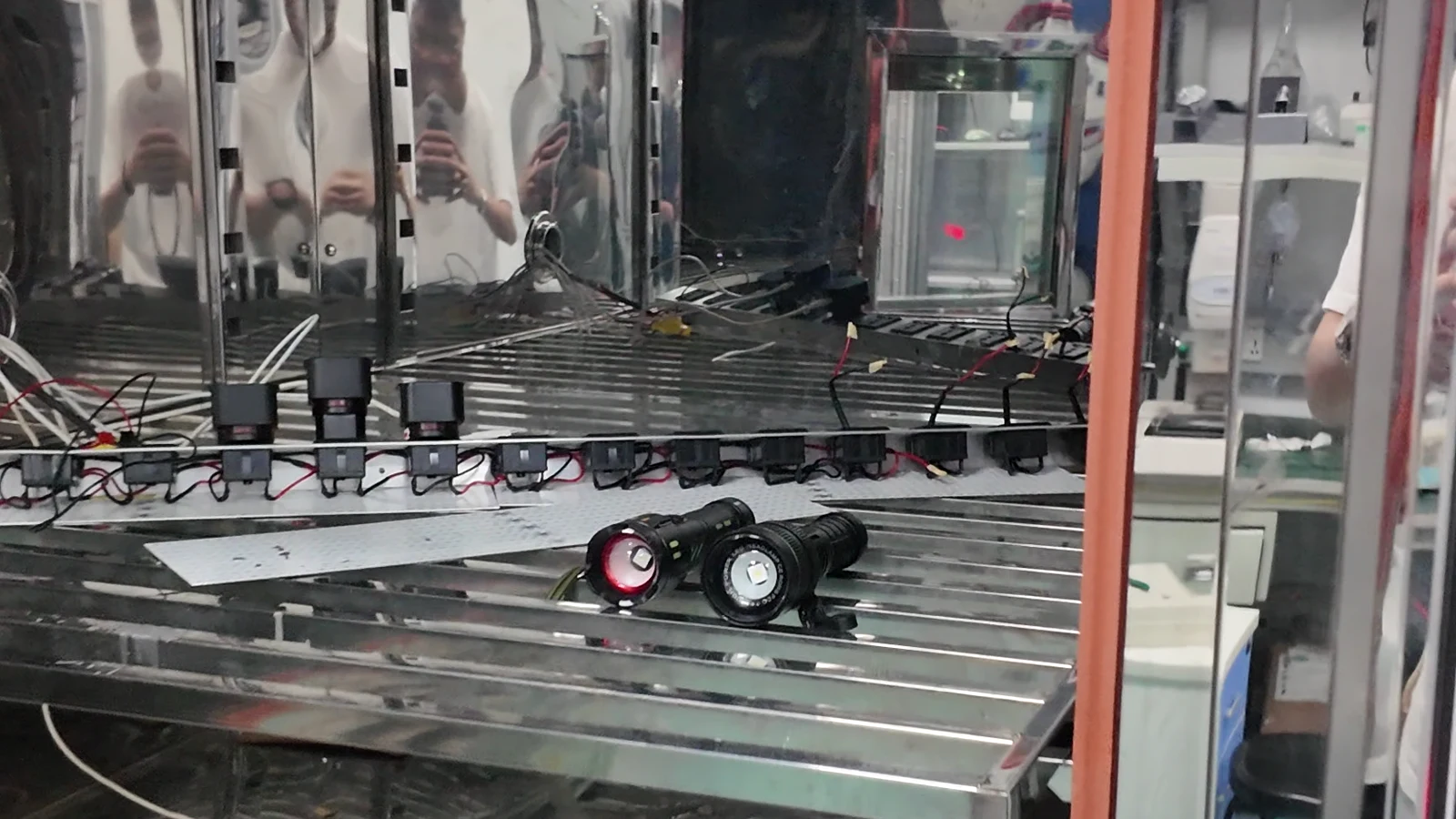
Real frame from supplied test footage. The image shows portable lighting samples inside an environmental chamber; it does not establish the test settings, duration, result, certification or ownership of the facility.
A climate-chamber photo proves only that a sample was placed in a chamber. It does not tell a buyer which sample was tested, what conditions were used, whether the light was on or off, what was checked afterwards, or whether the result met the stated requirement.
Before approving a rechargeable headlamp or portable work light, ask for two things: a short test plan before the run and a traceable evidence pack after it. Those two documents are far more useful than a dramatic temperature number or a few seconds of video.
Portable light temperature and humidity testing is useful only when the sample, profile, product state, recovery and pass/fail checks are defined.
This article is written for North American industrial supply distributors reviewing OEM or ODM samples. It does not prescribe one universal test profile. Storage, transport, charging and field use are different questions, and the right conditions depend on the product, its components, the intended application and any standard named in the buyer brief.
Start with the failure you are trying to prevent
The useful test is the one tied to a real failure risk, not the one with the most extreme-looking temperature.
A distributor may be concerned about a light stored in an unheated service vehicle, a headlamp that must start after cold storage, a work light operating for an extended period in a warm enclosed area, or moisture appearing after the product moves between different environments. These are not the same test.
Write the concern in one plain sentence before discussing equipment:
- Will the light start and change modes after the specified cold-storage condition?
- Can the housing, lens, switches and port covers be inspected after heat exposure?
- Does the complete unit continue operating in the selected mode during a controlled condition?
- Is there condensation, fogging or another visible change after recovery?
- Can the light charge and operate normally after the sample returns to the specified recovery condition?
This keeps the conversation connected to the buyer's market and use case. A supplier's standard test menu can be useful, but it should not replace the reason the test is being requested.
Put six decisions in writing before the chamber door closes
A useful chamber run starts with a one-page plan that identifies the sample, purpose, conditions, operating state, checkpoints and acceptance criteria.
| Decision | What the buyer and supplier should record |
|---|---|
| Sample identity | Model, sample revision, battery or cell version, charger version and any relevant bill-of-material reference |
| Test purpose | Storage, cold start, operation, temperature change, humidity exposure or another clearly named question |
| Test profile | Agreed setpoints, transition method, dwell time, number of cycles and recovery period |
| Product state | Off, operating, charging or another defined state; include the selected light mode and starting battery condition |
| Checkpoints | What is checked before, during and after the run, and when each check happens |
| Acceptance | Visible and measured pass/fail criteria, evidence format and the person responsible for reviewing it |
Do not leave the model revision as "current sample." Samples change. A housing material, gasket, driver, battery, cable or charger can be revised between quotation and approval. If the test record cannot be connected to a specific version, it becomes difficult to use later.
The same caution applies to the profile. A high or low setpoint means little without dwell time, transition method, product state and recovery conditions. When a project requires testing to a named standard or customer method, confirm the exact edition, clauses, setup and laboratory requirements before the test is quoted or run.
Test the product in the state customers will actually use
A switched-off light in storage answers a different question from a light running under load.
For each stage, say what the product is doing. A headlamp might be stored off and then checked for start-up and mode changes. A work light might be operated in one selected mode while key behavior is observed. A rechargeable product might be checked for charging only after recovery, depending on the limits defined for its battery, protection circuit and charger.
Do not assume that operating and charging conditions are identical. Charging limits must be confirmed from the approved battery, cell, charger and product design. If charging is part of the chamber plan, the supplier should show why the setup is appropriate and how it is monitored.
A photo may show wires or connected samples inside the chamber, as the supplied footage does. That still does not explain what each lead is connected to, what is being measured or where any sensors are placed. Ask for a simple setup photo or diagram with labels. It saves a surprising amount of discussion when the report arrives.
Ask for a record you can audit later
The evidence should let another person understand what happened without relying on a chat message from the test day.
Before the run
- Clear photos of the sample and its identification label
- The approved test plan and sample revision
- Baseline functional checks and any required measurements
- The initial battery condition and selected operating mode, when relevant
During the run
- The actual program or logged conditions, not only the requested profile
- Start and finish times, interruptions and any changes to the setup
- Sample position, product state and sensor locations
- Observations made at scheduled checkpoints
After the run
- The recovery condition and the time of the post-test check
- Housing, lens, seal, switch, hinge, clip and port-cover observations as applicable
- Start-up, mode selection, charging and light-output checks defined in the plan
- Photographs of any change, plus a clear pass, fail or investigation status
Video is useful supporting evidence, especially for controls and visible behavior. It is not a substitute for sample identity, logged conditions and written acceptance criteria.
Separate battery questions from housing questions
An environmental chamber run can show how a complete sample behaves under a defined condition, but it does not automatically prove runtime, battery capacity or long-term ageing.
For rechargeable portable lights, keep the battery questions visible:
- Is the battery or cell version the same one approved for production?
- What was the starting charge condition?
- Which light mode was used during any operating check?
- If the light stopped, what evidence separates normal depletion from protection behavior or another fault?
- Was charging checked after the sample returned to the defined recovery condition?
- If performance changed, was the sample inspected and the test repeated with a documented reason?
A chamber test and a runtime test can support each other, but they are not interchangeable. For a broader rechargeable-light brief, define the battery, charging interface, indicator behavior, operating modes and ageing checks separately in the rechargeable light buyer brief.
Define pass/fail criteria in plain language
"The supplier says it is okay" is not an acceptance criterion. Buyers need a short list that can be checked the same way before and after the run.
| Area | Example of a clear check |
|---|---|
| Light function | Starts, selects the required modes and remains stable during the defined observation period |
| Controls | Buttons, switches and dimming steps operate as specified |
| Housing and optics | No unapproved crack, deformation, loose part or persistent internal fogging after recovery |
| Seals and ports | Covers, gaskets and closures remain seated and usable on the inspected sample |
| Charging | Connector and indicator behavior match the approved sample after recovery |
| Mechanical features | Brackets, hinges, clips, handles and magnets remain secure and functional where fitted |
| Measurements | Required values are recorded with the specified method and equipment rather than judged from a photo |
The wording should match the actual product. A headlamp strap and hinge need different checks from a portable floodlight stand. Measured requirements also need the test method, equipment and tolerance defined; a phone photo of a bright beam does not establish light output.
One successful sample is not a production-control plan
A passing sample only supports the tested sample, version and conditions. It does not prove that every later production unit is identical.
After sample approval, connect the result to change control. Define which changes should trigger a review or retest, such as a different battery, housing resin, gasket, adhesive, driver, charger, lens or mechanical part. Keep the approved sample and report reference with the product specification.
Routine production checks usually answer a different question. They may cover appearance, assembly, switching, charging, accessories and packaging, while chamber testing is performed on a defined sample basis or after a relevant change. The exact sampling plan should be set for the product and buyer requirements rather than copied from another SKU.
This is where the OEM sample brief and the manufacturing and quality plan need to stay connected. A test report that is separated from the approved specification is easy to lose when production starts.
Send this request before sample approval
A short, specific request will usually produce better evidence than asking for "all temperature tests."
- Identify the exact sample and product revision.
- State the intended market, channel and use case.
- Name the failure risk or question the test should answer.
- Confirm the test profile, product state and recovery period.
- Define checks before, during and after the run.
- Agree the pass/fail criteria and any measurements.
- Request setup photos, logged conditions and a dated, traceable report.
- Record any interruption, anomaly or deviation instead of hiding it.
- Link the result to the approved sample and specification.
- Define which product changes require review or retesting.
Keep water exposure separate. Temperature and humidity testing does not replace an IP claim or product-specific water test. If outdoor exposure is part of the brief, define it separately using the questions in IP ratings and water tests.
Where one accountable team helps
The practical value of one coordinating team is a common test language across the product range.
A distributor may source several outdoor lighting product families, including headlamps, handheld lights and portable work lights, from different manufacturing partners. If each factory reports samples differently, the buyer spends time rebuilding the evidence instead of comparing products. A shared test-plan template, sample naming rule and evidence checklist makes review much clearer.
Through one coordinated OEM and ODM process, NIGHTFIELD can help turn the market, use case and product brief into consistent sample questions, coordinate the required evidence with the manufacturing partners involved, and keep open points tied to the correct product revision. That does not mean claiming ownership of every laboratory. It means keeping one line of accountability for what was requested, what was tested and what still needs confirmation.
Frequently asked questions
What does temperature and humidity testing prove for a portable light?
It can show how a clearly identified sample behaves under the exact conditions, product state, duration and checks written in the test plan. It does not prove performance outside that plan or establish that every production unit will behave identically.
Is a photo of lights inside an environmental chamber enough?
No. The photo is useful setup evidence, but the buyer still needs the sample identity, actual profile, operating state, timestamps, recovery conditions, pass/fail criteria and post-test results.
Should every headlamp and work light use the same chamber profile?
No. The profile should reflect the product design, battery and charger limits, intended storage and operating conditions, buyer requirements and any named test method. A profile should not be copied from another light simply because it uses the same type of equipment.
Does a temperature and humidity test replace an IP water test?
No. Environmental chamber testing and water-ingress testing answer different questions. Each needs its own setup, acceptance criteria and evidence.
What should an OEM supplier include in the report?
At minimum, include the product and sample revision, test purpose, actual conditions, product state, timestamps, setup, equipment identification, before-and-after checks, deviations, evidence and a clear result against the written acceptance criteria.
Source note: the article image is a frame from user-supplied video in the designated Nightfield material library. It is used to show the type of setup a buyer may see, not to claim a particular test result, certification, customer order or NIGHTFIELD-owned laboratory.